Chapter 14 of 'Pickwick Papers' is so full of incident in Bury St Edmunds - and the Angel - that Dickens titled
it: "Too full of adventure to be briefly described."
"'Beg your pardon, sir', said Sam, suddenly breaking off in his loquacious discourse.'Is this Bury St. Edmunds?' 'It is,' replied Mr. Pickwick. The coach rattled through the well-paved streets
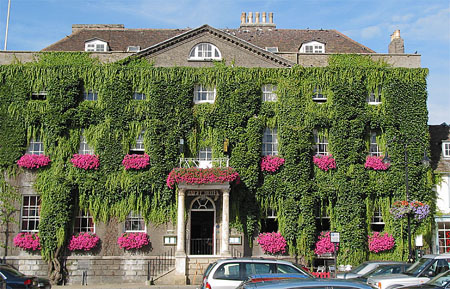
of a handsome little town, of thriving and cleanly appearance, and stopped before a large inn situated in a wide open street, nearly facing the old abbey. 'And this,' said Mr. Pickwick, looking up,
'is the Angel! We alight here, Sam. But some caution is necessary. Order a private room, and do not mention my name. You understand.' In half an hour, (with Sam's help) Mr. Pickwick was seated
at a very satisfactory dinner".
Later Mr. Pickwick was confined to his room in the inn with chronic rheumatism and here he received the news from Dodson and Fogg that Mrs Bardell intended to bring an action against him for breach
of promise. It was here in the stable-yard of the Angel that Sam Weller encountered the mulberry-liveried Job Trotter and innocently made Mr. Pickwick once more the victim of the devious Jingle.
Dickens knew the Angel well. He first stayed here in 1835 when he was reporting the Suffolk Parliamentary Elections for the Morning Chronicle. He stayed here again in 1859 when, as an established and
famous author, he gave readings in the Athenaeum which forms one side of this beautiful Georgian square. From the inn in he wrote: "Last night I read Copperfield at Bury St Edmunds to a very fine
audience. I don't think a word - not to say an idea - was lost".
Following another reading tour and whilst styaying in the Angel in 1861 he wrote: "we had a splendid hall last night, and that I think Nickleby tops all the readings! Somehow it seems to have got in
it, by accident, exactly the qualities best suited to the purpose, and it went last night, not only with roars, but with general hilarity and pleasure that I have never surpassed".
The Angel on the old fairground slope known as Angel Hill, was built as a hospice for the Abbey of Edmundsbury in 1452. The present Georgian building dates from 1799. Today there is a warm relaxed
atmosphere enhanced by an interesting collection of antiques and art.
Omar Khayyam was an eleventh-century Persian philosopher, mathematician, astronomer and poet whose verses were made famous in the
Western World by Edward FitzGerald. FitzGerald's celebrated translation and adaptations of Khayyam's poetry published as
'The Rubaiyat of Omar Khayyam' appeared anonymously in 1859 and passed unnoticed until
Dante Gabriel Rossetti made it famous.
Rubaiyat Revised editions followed in 1868, 1872, and 1879. Although it is actually a paraphrase, rather than a translation, it retains the spirit of the original in its poignant expression of a philosophy
counselling man to live life to the fullest while he can and has long been one of the most popular English poems.
FitzGerald came from a wealthy family and he owned a succession of large houses, but his domestic circumstances led him to move to a two roomed apartment "over Berry the gunsmith's shop" at number
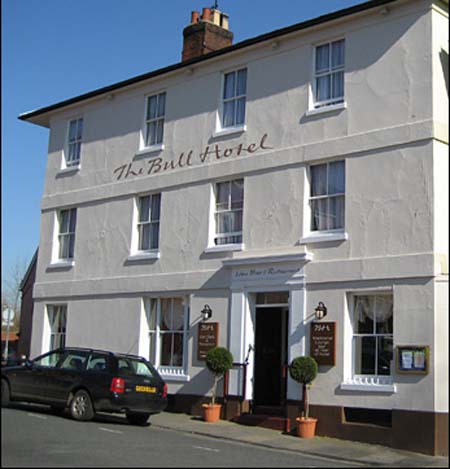
10 Market Hill, Woodbridge, where he lived for 14 years. A few metres up the hill was his favourite pub, The Bull, where he would meet with his literary friends - the self styled 'Wits of Woodbridge'.
In 1876 Alfred Tennyson and his son Hallam came to visit FitzGerald and put up at the former 16th century coaching Inn which dominates the bottom of Market Hill. At this time the inn's most famous landlord
was John Groats who also bred horses and sold them to - among others - the King of Italy, The Kaiser and the Viceroy of India. Groats didn�t take to the Poet Laureate and is reported as saying: "Well he
might be a fine poet but he doesn't know a damn' thing about horses".
The Bull is situated in the centre of the town and stands on the site of an older hostelry of the same name. The present building dates from the days when it was a posting house for the Union Coaches which
ran between Ipswich and Norwich. Something that is common in churches - but sadly lacking in pubs - is an historical list of incumbents. In the Bull there is a plaque on the wall of the bar listing all the
inn's landlords since 1734. Here you will find that Tennyson's John Groats presided from 1861 to 1887.
This family run hotel now provides all the modern facilities essential for the survival of a town centre hotel/pub, including a cafe bar, restaurant, and sports bar with plasma screen TVs. FitzGerald died
in 1883 and is buried nearby in Boulge churchyard. The rose tree over his grave came from hips brought from Omar Khayyam's grave at Naishapur.
Copyright T.W. Townsend - the opinions expressed herein are those of the author and any observations were correct at the time of the review.